
A website can look great and still bring in zero clients. The design gets compliments, but the form stays empty and the phone stays quiet. Most of the time the problem isn’t the style: key elements of a website that turn a visit into a conversation are missing.
In this guide we break down the 7 website elements you can’t skip and how to check each one. Tick the ones your site already has and you’ll see your score at the end.
- 01A clear value proposition
- 02One main CTA
- 03Trust signals
- 04Mobile-first design
- 05Page speed
- 06Frictionless contact
- 07Tracking set up
What is website design that converts?
It’s design built to make visitors do something: reach out, request a quote, book a call or buy. It isn’t measured by how pretty it looks, but by how many visits turn into sales opportunities. Aesthetics catch the eye; structure, message and ease of use decide whether the visitor acts.
That doesn’t mean visual design doesn’t matter: the design elements of a website build trust, and a sloppy site destroys it. But a beautiful site without these elements is a storefront with no door.
What is a clear value proposition?
It’s the message that tells visitors, in the first few seconds, what you sell, who it’s for and why they should choose you. It lives on the first screen of your site, the hero, and it’s the first thing people read. If visitors have to guess what you do, they leave.
Show your site to someone who doesn’t know it for 5 seconds and ask what you sell. If they hesitate or get it wrong, your value proposition isn’t doing its job.
Why should your website have one main CTA?
Because when many buttons compete for attention, visitors don’t know which one to tap, and often tap none. Your main CTA (call to action) is the button you want everyone to tap: "Get a quote", "Book a showing" or "Let’s talk". It should be visible without scrolling and repeated down the page.
You can have secondary actions, like "See listings", but they should look clearly less important: a different color, a smaller size or a plain link.
Count the buttons on your homepage. If several carry the same visual weight, pick the main one and tone the rest down.
What are trust signals on a website?
They’re proof that you’re real and that others already trusted you: reviews with names and photos, real photos of your team, licenses, guarantees or years in business. Someone who doesn’t know you needs a reason to believe you before handing over their details.
The key is that they’re real. A made-up testimonial or a stock photo passed off as your team is easy to spot and destroys the trust you were trying to build.
Look at your site as a stranger would. If it’s all text about how great you are and there’s no proof, this element is missing.
What does mobile-first website design mean?
It means the site is designed for phones first and then adapted to desktop, not the other way around. Many of your visitors arrive on their phones, so text must be readable without zooming, buttons must be easy to tap with a thumb and nothing should spill off the screen.
A site that merely "adapts" to mobile usually feels cramped, with tiny buttons and clunky menus. A mobile-first site puts what matters first from the start.
Open your site on your phone and try to contact yourself using only your thumb. If it’s a struggle for you, it is for your clients too.
Why does website speed matter?
Because a slow site loses visitors before it shows anything. Every second of waiting is a chance for visitors to hit back and pick another result. Speed also shapes the experience and is one of the factors Google takes into account.
The usual causes are heavy images, too many plugins and hosting that can’t keep up. The good news: measuring it is free.
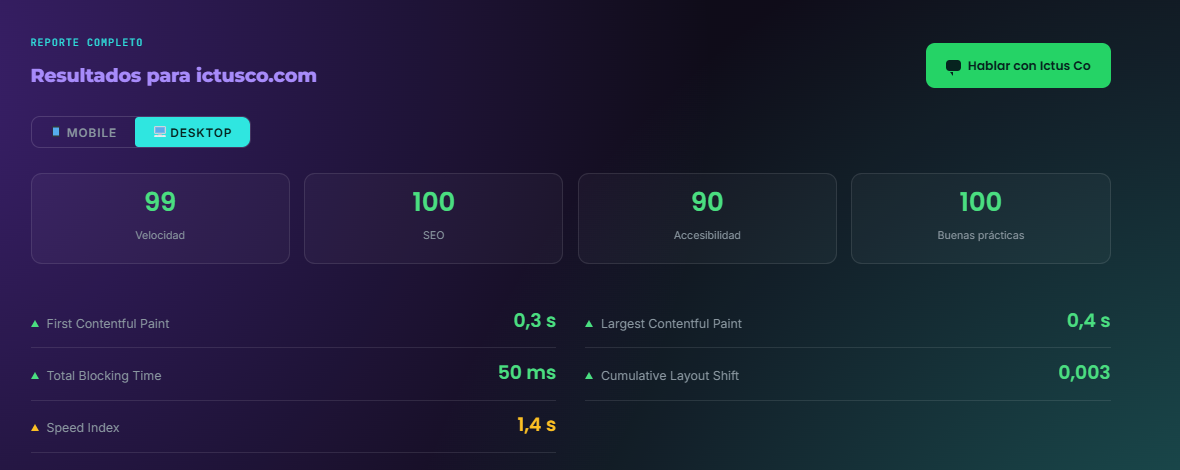
Run our free website audit, powered by Google PageSpeed Insights data, on mobile first and then desktop. Green (90 to 100) is good; orange or red means there’s work to do.
What is frictionless contact?
It’s making contacting you the easiest thing on your site: a short form with only the fields you need, a visible call or message button on mobile, and a phone number and email that can be tapped to call or write.
Every extra field is one more reason to abandon the form. A buyer inquiry only needs name, phone, email and what they’re looking for; the rest gets sorted out in the conversation.
Submit your own form and tap your call or message button from your phone. Did everything come through? Did it take less than a minute?
What does it mean to have tracking set up?
It means your site records when someone does what matters to you: submits a form, taps to call or sends a message. Without it, you only know how many people visit, not how many became leads. It’s the element almost nobody checks, and the one that tells you whether the other six work.
In Google Analytics 4 you do it with conversion events, like generate_lead for submitted forms or a custom event for call and message clicks. With that data you know which pages, campaigns and channels bring real clients.
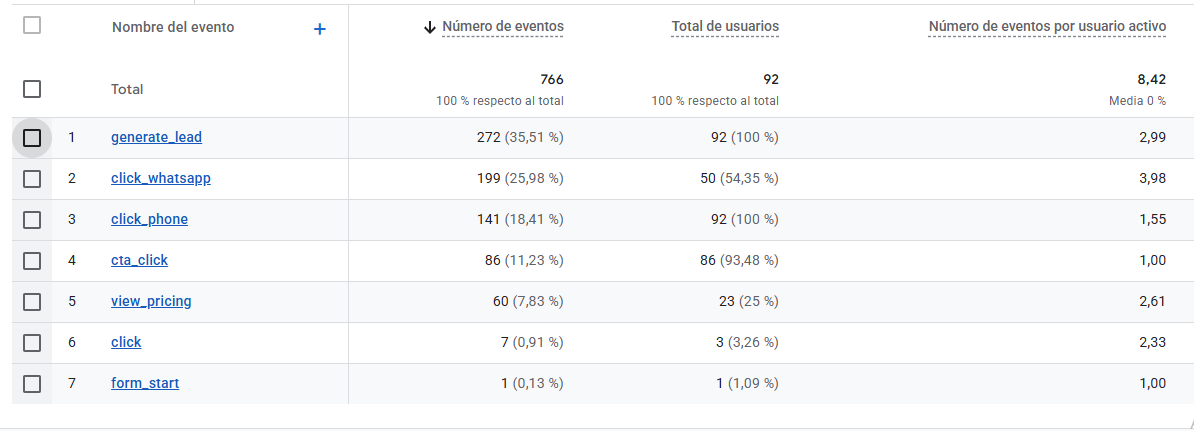
In Google Analytics, go to Reports › Engagement › Events. If you only see automatic events like page_view or scroll, you’re not tracking results.
How many elements of a website does yours have?
Count how many of the seven your site has today. If you ticked "My site has this" along the way, your result is highlighted below.
Your site most likely needs a redesign to start bringing in leads.
You’re losing clients, but targeted fixes make a visible difference.
Next step: measure and improve with the data you already have.
You don’t have to fix everything at once. Start with the missing element highest on the list: the value proposition and the main CTA are usually the changes that pay off fastest.
In short, a website that converts doesn’t depend on spectacular design, but on every element having a clear job: people understand what you sell, know which button to tap, trust you, can use it on their phone, it loads fast, contacting you is easy and you can measure what happens.
Check your website in a minute
The free website audit shows your site’s speed, SEO and accessibility with Google data. If you’d rather we review it with you, message us.
Frequently asked questions
There are seven: a clear value proposition, one main CTA, real trust signals, mobile-first design, fast page speed, frictionless contact and tracking set up so you know what works.
A clear value proposition, because if visitors don’t understand what you sell in the first few seconds, none of the other elements get a chance to work.
No. Visual design builds trust, but what makes people act is structure: a clear message, a visible main button and easy contact.
With the Ictus Co free website audit or directly in Google PageSpeed Insights. Enter your site’s address and you’ll get a 0 to 100 score for mobile and desktop, with recommendations to improve it.
It’s when a visitor takes the action you care about: submits a form, calls, sends a message or buys. You measure it by setting up conversion events in tools like Google Analytics 4.