
Many travel agencies sell through messaging apps and social media, and that has a hidden cost: the team spends the day answering the same questions about prices, dates and what each package includes, while clients go cold waiting. To show how good travel agency website design can change that, we designed Rumbo Travel.
Rumbo Travel is a fictional brand, created to show our design process: it isn’t a real client and it doesn’t present real results. As you read each decision, tick the ones your agency’s website already has.
- 01Search on the first screen
- 02A price on every package
- 03Browse by trip type
- 04A 4-field quote form
- 05Messaging to close
- 06Quote tracking
What problem does the Rumbo Travel website solve?
Too many repeated questions. Instead of clients messaging to ask about prices, dates or what a package includes, the site gives them that information on their own and leaves the agent only the part of closing the sale. The goal isn’t to replace the conversation, but to have it start further along.
Every section answers a question a client would otherwise send as a message. If the site answers it first, that question never reaches the inbox.
Why is the search bar on the first screen?
Because anyone landing on an agency’s site already has an intent: they want to know where they can go, when and for how much. Putting the search on the first screen meets that intent from the first second, with no menus and no messages.
The search asks for four details: destination, departure date, number of travelers and budget. They’re the same questions an agent would ask, and with them the site can already show matching packages.
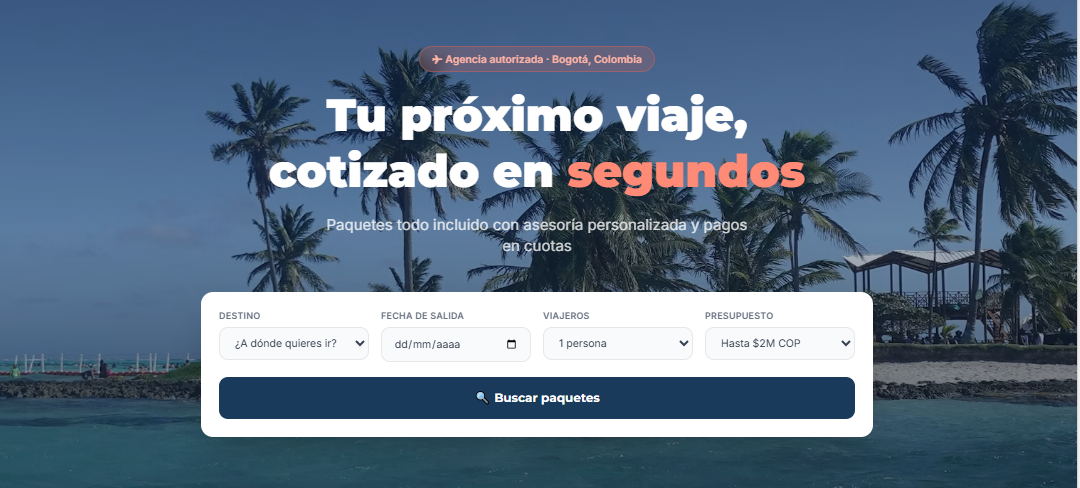
Open your site. If finding a trip means clicking through menus or contacting the agency, don’t tick this.
Why show the price of every package?
Because price is the question an agency gets most. Showing it, even as a “from” price, answers it before it arrives as a message and filters out people outside the range.
Each card shows the destination, nights, what’s included (flight, hotel, meals) and the price per person. Labels like “Best seller” or “Deal” help people decide fast.
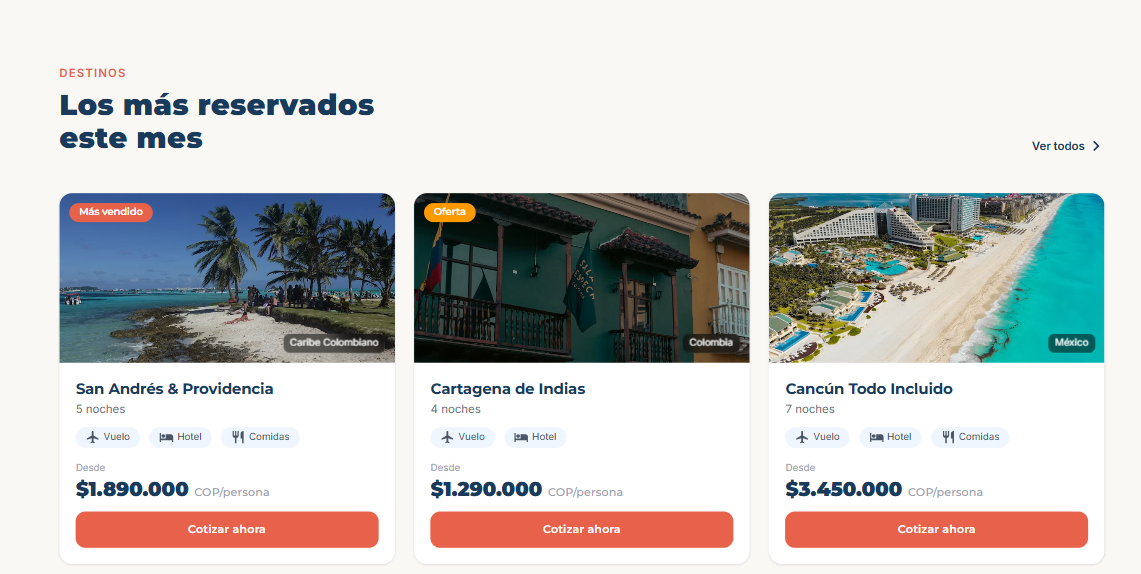
Look at your packages. If any of them doesn’t show price, nights and what’s included, don’t tick this.
Why let visitors browse by trip type?
For the client who doesn’t know where to go yet, but knows what kind of experience they want. Instead of starting with a destination, they start with how they want to feel: beach, adventure, romantic or family.
The section also inspires: it shows options the client may not have considered, and every category leads to specific packages with prices.
If your site only lets people search by destination and not by trip type, don’t tick this.
Why does the quote form have only 4 fields?
Because every extra field is one more reason to abandon the form. With name, phone, destination and approximate dates, the team can already prepare a quote. Everything else is settled in the conversation.
The form promises a reply within an hour. A commitment like that builds trust, but only if the team can keep it: a broken promise does more damage than no promise at all.
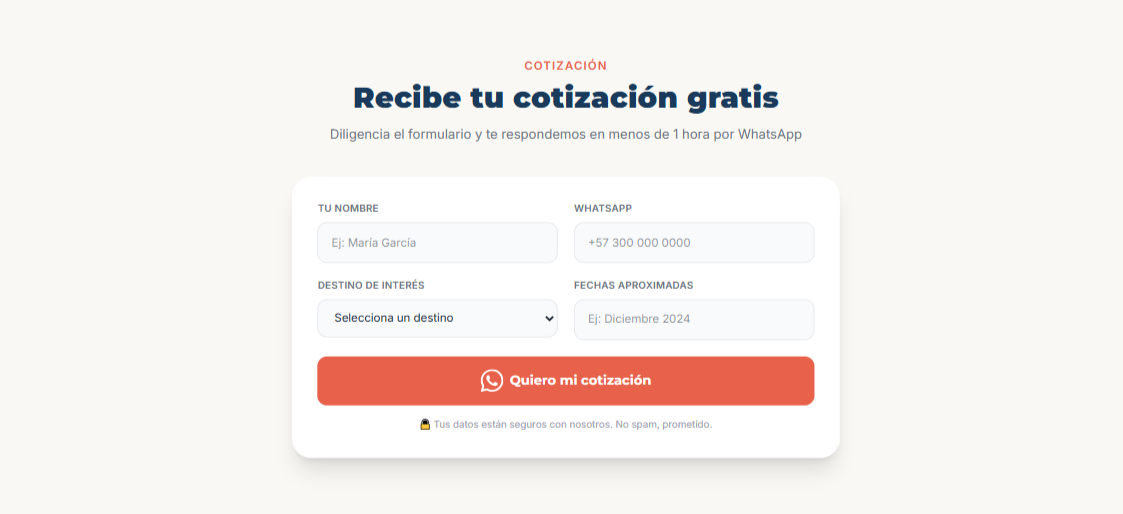
Count the fields on your quote form. If there are more than five, don’t tick this.
Where does messaging fit on a site that sells trips?
At the end of the journey, as the channel to close the sale. Messaging stops being the inbox where every question lands and becomes the place where the purchase happens, with a client who has already seen prices and left their details.
The floating button stays visible for anyone who prefers to write directly, but the site is built so the conversation starts much further along.
If your inbox gets mostly questions your site should already answer, don’t tick this.
How do you measure whether a site like this works?
With conversion events, not just visits. Since Rumbo Travel is a concept case, it has no real results, but these are the metrics we would set up from day one: how many people use the search, which packages get the most clicks, how many submit the quote form and how many tap to message.
In Google Analytics 4, the form is tracked with the generate_lead event and message clicks with a custom event.
Ask yourself how many quote requests came from your website last month. If you don’t know, don’t tick this.
What can your travel agency apply today?
Even without a redesign, you can start with what you didn’t tick. If you ticked along the way, this is your result:
Your site shows, but it doesn’t quote. Start with prices and the form.
Key pieces are missing. Fix first the ones that save messages.
Your site already works for you. Next step: measure and improve with data.
Every decision behind Rumbo Travel starts from one simple question: does this save the client a message or bring them closer to buying? A travel agency website doesn’t have to be a pretty showcase: it can answer the usual questions, guide clients to the right package and leave the team the part that truly needs a person, which is closing the sale.
To see what else a website needs to convert, read the 7 elements of a website that converts. And to see the same approach in another industry, check the dental website design concept case.
Check how your website performs today
The free website audit shows your site’s speed, SEO and accessibility with Google data. If you’d rather talk about a website that quotes for you, message us.
Frequently asked questions
It’s a project we design for a fictional brand to show our process and design decisions. It isn’t a real client and it doesn’t present real results.
A search on the first screen, packages with a “from” price, nights and inclusions, a way to browse by trip type, a short quote form, messaging to close the sale and tracking for quote requests.
In most cases, yes. A “from” price answers the most common question, filters out people outside the range and means clients who reach out arrive with clearer intent.
The minimum needed to start a quote. For a travel agency, four are usually enough: name, phone, destination and approximate dates. The rest is settled in the conversation.
No. The site answers repeated questions and guides the client, and messaging stays as the channel to close the sale with someone who already knows prices and options.